
Accueil > Newsfeed > Students are being funneled into Google’s ecosystem
Students are being funneled into Google’s ecosystem
mardi 24 mars 2026, par
If you’re the parent of a student, you’re familiar with the many ways technology plays a role in your child’s education.
What you may not realize is that the free laptop your child’s school provided, or the software it runs, may be tracking your child’s every move .
The pervasive use of free laptops and educational software (happening at all grade levels in the United States) means that kids are being funneled into technological ecosystems without parental consent. This should sound alarm bells for parents everywhere.
According to the Electronic Frontier Foundation (EFF), students are commonly issued free educational technology (ed tech) like Google Chromebooks, Apple or Windows laptops, and tablets like the iPad or Microsoft Surface, directly through their schools. This has led to various issues.
For example, in Robbins v. Lower Merion School District , a school district issued students free MacBook laptops with built-in webcams and then secretly captured more than 66,000 images, including of students in their bedrooms at home.
The broader privacy concern is that schools require students to learn inside Big Tech platforms like Google that can collect, centralize, and retain huge amounts of personal information as part of everyday classroom life. How Google turns classrooms into data pipelines Parents push back through lawsuits Onboarding “loyalty for life” How to keep your child safe A safer digital start for students
How Google turns classrooms into data pipelines
Schools often rely on Google Workspace for Education and Microsoft 365 Education for homework, class communication, document sharing, and grading, which means a large share of student activity passes through a small number of Big Tech platforms.
Google says Workspace for Education accounts are governed by a special education privacy notice, and Microsoft says its services process personal data and collect diagnostic data to keep products secure and functioning. That does not automatically mean either company is selling student data, but it does mean these systems can become large, centralized pipelines for student information.
Once a child’s school life runs through those platforms, a lot of sensitive information can pile up in one place : names, school email addresses, class rosters, assignments, messages, files, login history, device information, and sometimes data shared with connected third-party apps.
Google’s own school guidance says administrators may enable third-party services with students’ accounts and authorize disclosure of data requested by those services, and it advises schools to communicate with parents and obtain consent where appropriate.
Given Google’s long record of privacy controversies, investigations, settlements, and billion-dollar fines , parents have reason to be skeptical of privacy promises that exist mainly on paper.
When so much student activity flows through a single corporate ecosystem that retains ongoing access to data, it becomes easier to build detailed profiles of children’s behavior, habits, and online activity, often without families fully understanding what is being collected. Even if that data is not used for advertising, it can still be shared with third parties, disclosed in response to government requests, used to train AI systems , or exposed in a breach , including in ways that could enable deepfake abuse.
Parents push back through lawsuits
A federal lawsuit (Schwarz v. Google LLC ) filed in San Francisco in 2025 US District Court alleges that Google uses tracking technology to record students’ internet activity, including the websites and apps they use, to create a profile, or fingerprint , specific to each student, without parental consent. The lawsuit claims that these detailed student fingerprints enable Google to target schools for its own marketing purposes, using highly curated advertisements with specific data about enrolled students to sell more products.
In 2020, a federal lawsuit filed in New Mexico alleged that Google secretly collected student information, including location data, internet history, search terms, YouTube history, contact lists, passwords , and voice recordings.
Both lawsuits claim that Google violated the Children’s Online Privacy Protection Act (COPPA), which requires companies to obtain “verifiable parental consent” for children under 13 if personal data is being collected.
If a school pays for and uses an educational ecosystem, there are typically no alternatives . Some school districts offer students a way to opt out, but many don’t. Instead, most students at schools that use Google’s Workspace for Education or Chromebooks are expected to use those products, giving Google unrestricted access to their own data.
Onboarding “loyalty for life”
According to the plaintiffs in Schwarz v. Google, close to 70% of schools in the United States use Google’s Workspace for Education products in classrooms. More than 30 million students, teachers, and administrators use Google’s Workspace for Education services, the EFF said.
The plaintiffs claim that Google’s services violate the Fourth Amendment, the Children’s Online Privacy Protection Act, and the California Invasion of Privacy Act .
Google has denied these allegations , but leaked documents of internal Google presentations show the company’s organized efforts to encourage dependence on their products, starting from an early age.
These presentation slides show the tech giant making arguments for “onboarding kids into Google’s ecosystem ” to build brand loyalty and trust over the span of a student’s lifetime — much like Meta’s internal culture has been described as viewing children not just as users to protect, but as a target audience to capture early and retain for years.
Included in Google’s documents are calls to “invest in schools,” emphasizing brand awareness, using Google Chromebooks in schools to influence purchasing patterns and decisions at a later age, and earning “loyalty for life,” beginning in the school system.
Attorneys representing Google argue that per COVID-era Federal Trade Commission rules, the tech giant does not need consent from parents , just schools, to be in compliance with the Children’s Online Privacy Protection Act.
Google says that it does not use student data to target ads, but the company has faced similar allegations — and lost — before. In 2019, the Federal Trade Commission (FTC) fined Google $170 million for “knowingly and illegally” harvesting personal information from children and using it “to profit by targeting them with ads,” according to The New York Times .
In 2022, the advocacy group Human Rights Watch analyzed 164 different ed tech apps and websites across 49 countries, determining that 89% of such products had the capability to infringe on student privacy.
How to keep your child safe
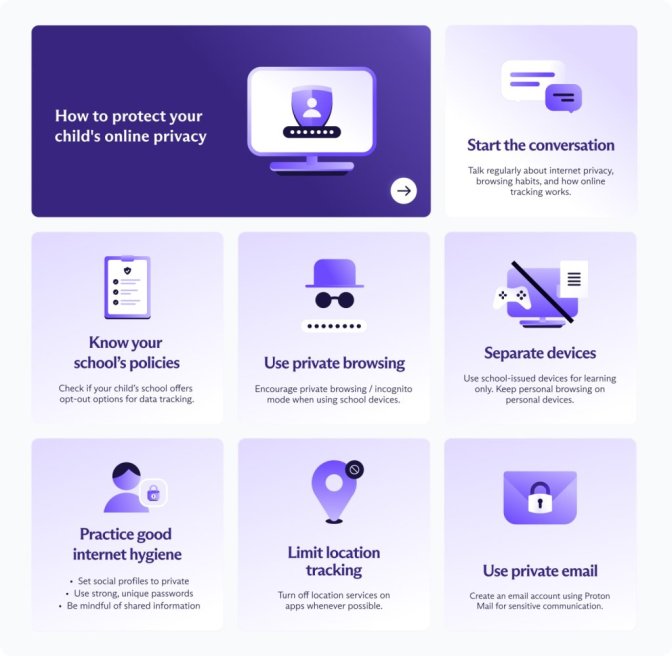
School is meant for learning, not data mining. Here’s what you can do to keep your child safe : Talk to your child about the importance of internet privacy. Have routine conversations about browsing habits and why the tracking of their online movement matters. Check with your child’s school district to see if an opt-out alternative is provided. Advise your child to use Incognito mode when using Google Chrome or a Google Chromebook. Encourage your child to use their school-issued laptop or tablet only for educational purposes and use a personal device for browsing and social media. Discuss good internet hygiene, such as making social media profiles private, creating strong passwords , and more. Turn off location tracking on your child’s apps. Create a free Proton Mail account for your child so their sensitive information is always encrypted.
A safer digital start for students
Your child’s privacy shouldn’t have to be sacrificed to go to class. And all students, no matter where they live, should have the right to begin their digital life without being tracked, profiled, or treated as a source of data for Big Tech.
At Proton, we believe privacy is a fundamental right, not a tradeoff to be exploited by Big Tech companies like Google for their own purposes. A child’s first email address often becomes a lasting part of who they are online, which is why that first step should begin with privacy, not surveillance.
With Proton Mail, parents can reserve a private email address for their child, giving them a safer start online before school platforms, games, and apps begin demanding access to personal information.
Proton — with no investors or ad revenue, and backed by our majority shareholder, the nonprofit Proton Foundation — is dedicated to building a safer, more open internet for everyone, including kids. Unlike Big Tech platforms built around data collection, Proton Mail is designed to protect your child’s information by default with end-to-end and zero-access encryption , and a business model that does not depend on exploiting personal data. Reserve your child’s private email
Voir en ligne : https://proton.me/blog/ed-tech-stud...