 Family
Accueil > Newsfeed > Former Rainforest Café and Capone’s Chicago : What's That Building ?
Former Rainforest Café and Capone’s Chicago : What's That Building ?
mardi 10 février 2026, par
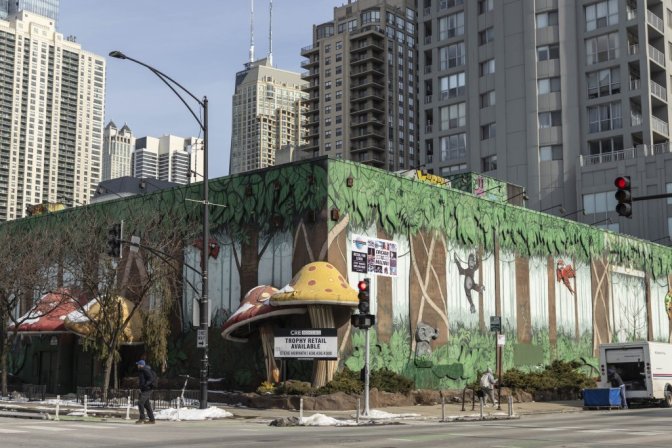
If you roll your eyes when passing the corner of Clark and Ohio streets in River North, you’re not the only one. Sneering or even clutching your pearls go back more than 30 years on this site, to the early 1990s.
The vacant building on the northeast corner looks a little ridiculous, its doorway flanked by giant, colorful mushrooms and its blocky shape draped with ersatz jungle vines, trees and animals.
Oversized mushrooms still decorate the building’s exterior.
K’Von Jackson for WBEZ
The cartoonish look used to make more sense before the signage for the old Rainforest Café was removed after the https://blockclubchicago.org/2020/0... restaurant closed in the summer of 2020.
But it’s not only the present look of the building that causes eye-rolls. That goes back much farther, back before the Rainforest Café to the site’s previous attraction.
That was https://www.americanheritage.com/ca... Capone’s Chicago, which opened on this corner in June 1993 and sparked a round of pearl-clutching.
The establishment was a retelling of the Roaring ‘20s in Chicago, with https://www.americanheritage.com/ca... animatronic figures of Al Capone and other mobsters — as well as Louis Armstrong, who lived and performed in the city in the 1920s. The 30-minute show also featured an animatronic Carry Nation, the hatchet-wielding Temperance activist.
The exterior of what used to be Capone’s Chicago.
Robert A. Davis/Chicago Sun-Times
Capone’s Chicago was like the Hall of Presidents at a Disney theme park, only it told a story some Chicagoans would rather not showcase.
“We do not use the gangster image to promote Chicago,” an official at the city’s Office of Tourism huffed to https://www.deseret.com/1993/6/26/1... The Associated Press.
You can see photos of the interior here .
Some people of Italian descent were offended by the enshrinement of mobsters. A leader of an Italian American civic committee told https://www.deseret.com/1993/6/26/1... The Associated Press that Capone’s Chicago was “an ugly stain on the face of Chicago.”
Intended for families, the show didn’t depict the murderous brutality of events such as the St. Valentine’s Day Massacre. Instead, in the words of a 1994 https://www.newspapers.com/image/24... Chicago Tribune article, it “transforms the notorious Capone into a smiling, chipmunk-cheeked character who might as well be known as Uncle Al.”
Capone’s Chicago was a co-production of https://www.chicagotribune.com/1991... Michael Graham, a Capone memorabilia collector, and Patricia McHugh, scion of a long-running Chicago construction firm. McHugh told the Tribune around the time of the grand opening that they had made a point of saying in the show that not all gangsters were Italian and that Capone’s parents worked hard.
“We’re trying to put a positive spin on the era,” McHugh said.
The building’s exterior, made to look like a 1920s Chicago street of mixed facades, was meant “to feel like Main Street USA,” she said.
Capone’s Chicago under construction.
Robert A. Davis/Chicago Sun-Times
Capone’s Chicago had been open for just three years when, in June 1996, Patty McHugh https://www.chicagotribune.com/1996... announced it was closing. She said she “got an offer I couldn't refuse.” McHugh, still an executive at the family construction firm, didn’t respond to requests to comment for this story.
The buyers, who https://crs.cookcountyclerkil.gov/D... paid a little over $2.55 million for the building, were investors led by former state Sen. Bill Marovitz. The group planned to turn the spot into a sports-themed restaurant.
People bothered by Capone’s Chicago rejoiced.
“We greet the news with a sigh of relief and exultation,” https://www.newspapers.com/image/16... said the Italian American who had earlier called the attraction a “stain.” As well as an insult to Italian Americans, he said, “it was an architectural monstrosity.”
But sneering about the site at 605 N. Clark did not remain quiet for long. Just a few months later, Marovitz announced that instead of Skybox Chicago, the old Capone’s building would https://www.newspapers.com/image/16... become a Rainforest Café.
Launched in 1994 in the Mall of America in Minnesota, the https://www.atlasobscura.com/articl... Rainforest Café was built around a 1990s fascination : the endangered tropical rainforests rapidly being lost. The restaurants contained working waterfalls, artificial palm trees and animal figures.
Chef Dave Kile stands next to the animatronic elephants in the restaurant in 1997.
Robert A. Davis/Chicago Sun-Times
False jungle foliage, alligators and parrots, and a giant tree frog over the door replaced the fake Capone-era storefronts.
The rainforest decor remains on the building’s exterior.
K’Von Jackson for WBEZ
And the eye-rolling started all over again.
The new look suggested a “fourth-grader’s papier-mache project,” a Chicago Sun-Times reporter wrote, “with multicolored toad stools and flourishes of painted-on flora.”
In Skyline, a columnist https://www.chicagotribune.com/1997... wrote that the building had “a grotesque façade (featuring) a leering, bilious, repugnant green frog. To those responsible for this repulsive tourist trap : Do you hate Chicago ?”
A giant frog decoration is being installed on top of the Rainforest cafe ahead of its opening in 1997.
Chicago Sun-Times file photo
Despite all the pearl-clutching, the Rainforest Café thrived on that corner, lasting from 1997 until it closed in August 2020, one of countless restaurants that shuttered during the COVID-19 pandemic.
Five and a half years later, the building sits empty. There was an attempt to https://chicago.suntimes.com/cannab... turn it into a cannabis dispensary, but that fell apart amid lawsuits and questions about proximity to similar businesses.
Since 2015, when the Rainforest Café was still up and running, the property has been owned by an investment partnership led by Sean Conlon, a former Chicago real estate tycoon who now lives on a small island in the Caribbean and runs a merchant bank. The group https://crs.cookcountyclerkil.gov/D... paid about $13.7 million for it, according to the Cook County Clerk.
The building is considered a “trophy property” because of its location.
K’Von Jackson for WBEZ
“It was a trophy property, that corner,” Conlon told WBEZ’s “In the Loop” over the phone from his island home. “With Rainforest Café there, it would pay income for the rest of your life. Well, nobody had worked the pandemic into their business plan.”
Though he https://blockclubchicago.org/2020/0... told Block Club Chicago in 2020 that, with the Rainforest Café going away, the site might be right for a new residential tower, Conlon now has other plans.
His firm bought the California-based gaming technology firm Teamspeak a few years ago, and Conlon said he is now developing an idea to transform the structure as yet another venue : a Teamspeak-branded competitive gaming facility.
In October, the lender of an $8.3 million bridge loan on the property started a https://chicago.suntimes.com/real-e... foreclosure suit against Conlon’s partnership. Conlon told WBEZ he has since refinanced this and other properties ; Cook County public records don’t yet indicate that has happened.
Dennis Rodkin is the residential real estate reporter for Crain’s Chicago Business and In the Loop’s “What’s That Building ?” contributor. Follow him @Dennis_Rodkin.
K’Von Jackson is the freelance photojournalist for In the Loop’s “What’s That Building ?” Follow him @true_chicago .
Voir en ligne : https://www.wbez.org/architecture/2...