 Family
Accueil > Newsfeed > Art Institute of Chicago hangs Norman Rockwell painting of the Cubs
Art Institute of Chicago hangs Norman Rockwell painting of the Cubs
mardi 10 février 2026, par
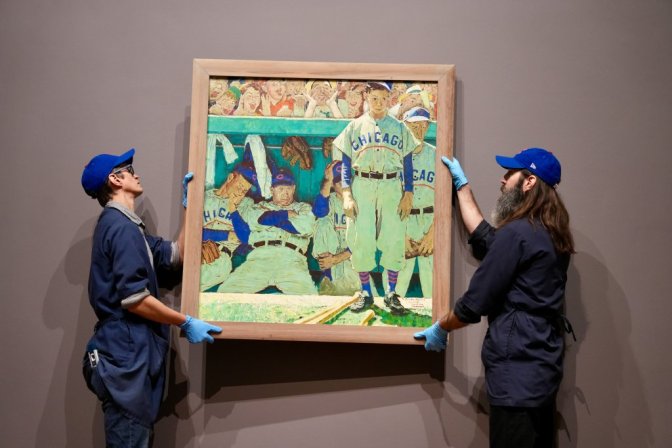
In what will likely be a major draw for the museum, the Art Institute of Chicago on Tuesday installed its first-ever Norman Rockwell painting, and it depicts the Chicago Cubs.
“The Dugout,” Rockwell’s 1948 artwork, ran as a cover of the Saturday Evening Post. The work shows dejected Cubs players whose faces hang long after losing a doubleheader against the Boston Braves. Behind them, Braves fans appear to howl with delight, reveling in their team’s victory.
You’re subscribed !
Please check your inbox for your confirmation. Stay ahead of what’s hitting Chicago stages, galleries, museums and more with Green Room, WBEZ’s weekly arts & culture newsletter !
Sorry, there was an error registering your email. Email Submit
By subscribing, you agree with WBEZ’s Terms of Use and Privacy Policy
The historic piece is a gift to the Downtown museum from former Illinois Gov. Bruce Rauner and his wife, Diana. According to an online listing from the auction house Christie's, “The Dugout” last sold in 2009 for $662,500. The company estimates its present-day value between $700,000 and $1 million. Other Rockwell works have fetched as much as https://www.npr.org/sections/thetwo... $46 million.
On Tuesday morning, the iconic slice of American art history with special hometown ties took its place among the Art Institute’s sprawling collections.
Inside a gallery in the American art wing, curator Sarah Kelly Oehler welcomed two handlers who wheeled in the painting on a cart, each of them wearing Cubs caps and surgical gloves as they carefully hung the work on the wall. Looking on were the Rauners and https://chicago.suntimes.com/art/20... James Rondeau, the museum’s president and director. Rondeau called the painting a “truly transformative acquisition.”
The former governor said the work is his favorite painting, but as he approaches his 70th birthday, he said it felt like the right time to make the gift. This is the Rauners’ first donation to the museum, other than being members for a “gazillion years,” Diana Rauner joked.
“We enjoyed the painting for a very long time, just in our home, and in our family,” Diana Rauner said. “But it's really a painting for our community, and so we wanted to share it with the Chicago community.”
Rockwell’s “Dugout” now resides directly across from another legendary work, Grant Wood’s “American Gothic,” which is an Art Institute highlight. Oehler hopes the Rockwell piece, on view to the public starting Wednesday, will also become a popular destination for museum visitors.
Norman Rockwell. The Dugout, 1948. Gift of The Honorable Bruce V. Rauner and Diana M. Rauner. Dugout illustration © SEPS licensed by Curtis Licensing. All rights reserved. Norman Rockwell’s “The Dugout” depicts five people who participated in a 1948 baseball game between the Chicago Cubs and the Boston Braves. From left : Cubs rookie pitcher Bob Rush (1) ; Cubs manager and former first baseman Charlie Grimm (2) ; Cubs catcher Rube Walker (3) ; Braves batboy Frank McNulty (4), posing in a Cubs uniform ; and Cubs pitcher Johnny Schmitz (5).
“We will have two icons standing shoulder to shoulder, looking at one another, because they're so thematically appropriate to be together,” Oehler said. “What is more American than baseball ? And certainly our own Chicago Cubs, so it just seemed like the absolutely perfect place to put it.”
Although it was a magazine cover commission, this realistic work is an early draft — or “study” — when Rockwell was working out the details. And unlike the final product, this version measures more than 3 feet, both in length and height.
Oehler said the Art Institute has been in conversation with the Rauners about the piece for the last 10 months and officially received the gift in late December. On average, the museum https://www.wbez.org/museums/2026/0... adds about 1,000 works to its already massive collection annually. For Oehler, this is a standout.
“I've long identified a Norman Rockwell as being something that we would want in the collection,” said Oehler, who oversees the museum’s American art collection and is the vice president of curatorial strategy. “I never dreamed, I will admit, that it would be this particular Norman Rockwell, that it would be such a perfect Chicago painting.”
Former Gov. Bruce Rauner and his wife Diana Rauner answer questions after “The Dugout,” a Norman Rockwell painting and a new addition to the wing, is installed at the Art Institute of Chicago. The Rauners donated the painting to the museum.
Pat Nabong/Sun-Times
Despite being immortalized by Rockwell, the 1948 Cubs were not a stellar baseball team. In fact, their lousy record is what intrigued the artist. In May of that year, Rockwell convinced some good-natured players to model for him.
Ultimately, the work shows rookie pitcher Bob Rush ; Cubs manager Charlie Grimm, who had also played for the Cubs as a first baseman ; catcher Rube Walker, whose hat is pulled down over his eyes ; and All-Star pitcher Johnny Schmitz with a furrowed brow. In the foreground, a batboy with a raised eyebrow steals the scene. In reality, the batboy, Frank McNulty, worked for the Braves, but after Rockwell offered him $5, he agreed to model in a Cubs jersey, according to Oehler.
Rockwell also recruited spectators to sit above the dugout and make faces of both delight and disappointment, according to an https://www.saturdayeveningpost.com... article published online for the cover’s 70th anniversary in 2018.
The artist captured his models in a series of photographs. Then, according to Oehler, Rockwell used the photos to draft several iterations of the cover before it ran in September. First, Rockwell sketched in black-and-white graphite, then created the detailed oil painting that’s now at the Art Institute.
“It's very painterly. It has this beautiful sense of light and color,” Oehler said. “There's this wonderful green glow to it that is quite different from the actual cover. So it's really him working as a painter to try out these ideas and play with contrast and tonalities in the composition.”
Tim Roby (left), department specialist of the Arts of the Americas at the Art Institute of Chicago, and Chris Shepherd, senior specialist of the Arts of the Americas, roll in a “The Dugout” by Norman Rockwell.
Pat Nabong/Sun-Times
Rockwell was born in 1894 in New York and became one of the most famous artists working in the 20th century. His detailed depictions of everyday life mostly entered Americans’ homes through his famous magazine covers.
Rockwell is perhaps most closely associated with the Saturday Evening Post. Over a nearly five-decade run, Rockwell produced https://www.saturdayeveningpost.com... 322 covers for the publication, which at its peak in 1960 boasted a circulation of nearly 7 million — driven, in part, by Rockwell himself.
Despite widespread popularity, his longstanding relationship with the magazine is also what sometimes gives Rockwell’s work a reputation of being exclusionary. These illustrations almost always depicted white Americans, including what is perhaps Rockwell’s most famous work, “Freedom of Speech,” in which a man stands in dissent at a local town meeting.
However, later in his career, Rockwell famously drew scenes from the Civil Rights Movement, including “The Problem We All Live With,” which depicts a young Black girl accompanied by U.S. marshals as she encounters overt racism on her way to school. The work for Look magazine was inspired by Ruby Bridges, who in 1960 became the first Black student to integrate her formerly all-white school in Louisiana.
“I think what Rockwell really did was capture a sense of the United States throughout a long and turbulent history,” Oehler said. “While sports were clearly so central to his practice and to his work, he also did works about much more difficult subjects.”
Last fall, some of https://www.usatoday.com/story/opin... Rockwell’s descendants rebuked the Trump administration’s use of his artwork on social media to, as they wrote for USA Today, persecute immigrant communities and people of color.
“We — as his eldest son, grandchildren and great-grandchildren — believe that now is the time to follow in his footsteps and stand for the values he truly wished to share with us and all Americans : compassion, inclusiveness and justice for all,” the family wrote.
Courtney Kueppers is an arts and culture reporter at WBEZ.
Voir en ligne : https://www.wbez.org/arts/2026/02/1...